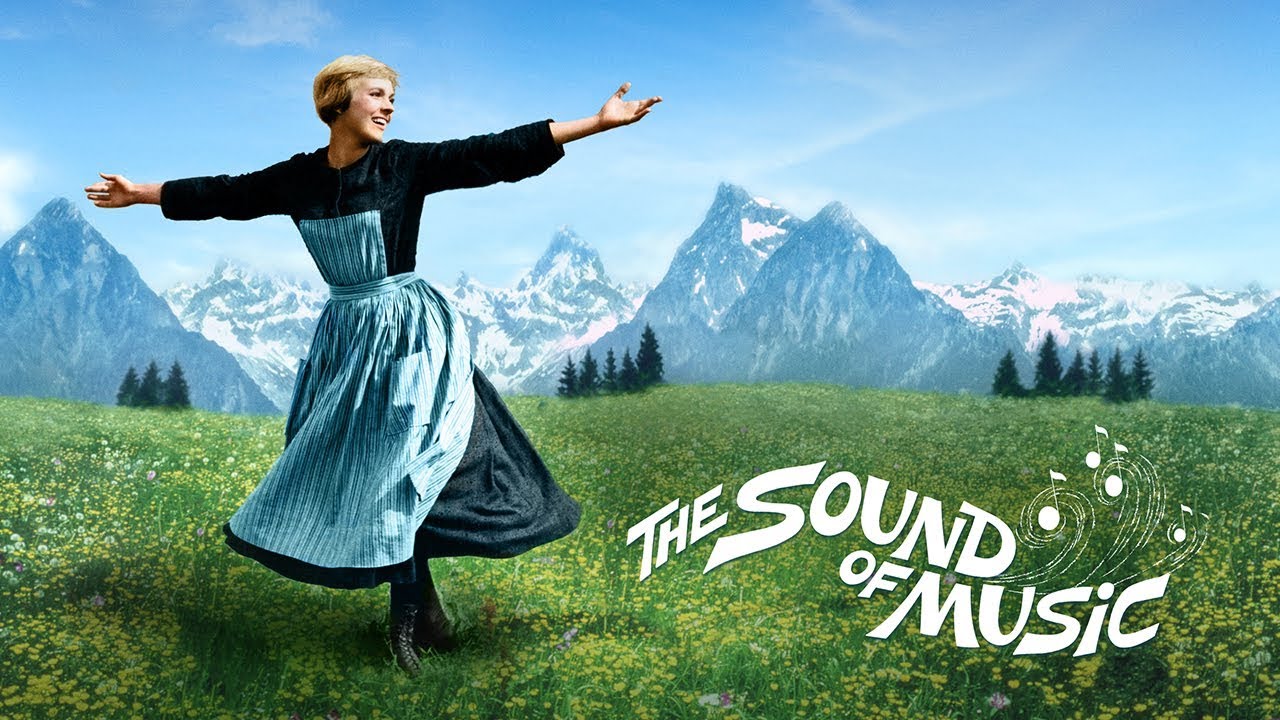
The Sound of Music trades on our longing to enter a world that is uplifted and transformed by art. It is romantic in the sense that it is a love story, but also in the dictionary sense that it “gives free rein to the imagination; indulging in fancy or fantasy; fanciful; sentimental; idealistic.” Though I came to the movie to escape a world that is not what it should be, I couldn’t help but notice that the conservative story about family and nation that it tells bears resemblance to some of the central fantasies of Donald Trump’s America.
The movie begins when the aspiring nun Maria is judged unfit for cloistered life because she sings at inappropriate times, wears curlers in her hair, and is always late for things. The Reverend Mother decides that the only way to “solve the problem” of Maria is to send her away to serve as a governess of the seven children of the widower Captain Von Trapp. Her solution is to redirect Maria’s desire from God towards a husband, to launch her out of one sentimental female narrative and into another. The momentum of the first part of the story arises from our suspense about whether or not Maria will find her place in the conventional female plotline that is newly available to her. To our satisfaction, the Reverend Mother’s scheme is successful. The recalcitrant energies that Maria’s singing had presented in the Abbey become the glue that holds her new, large family together.
The Sound of Music tells a story in which music unifies the domestic community, upholding traditional gender roles. Maria reforms the militaristic system of discipline that Von Trapp, a naval hero, has imposed on his children by bringing music into their lives. The Captain, who has long repressed his own musical talents, falls in love with Maria and replaces the abrasive whistle that he had used to summon his children with a guitar that he uses to win her heart. It seems as if all members of the Von Trapp family are on an equal footing once they start harmonizing together, but Maria’s program of aesthetic education arguably reinstates the disciplinary norms of the heteropatriarchal family on a more mild and enduring foundation. Captain Von Trapp is, as he himself announces, the head of the family and Maria and the children must submit to him even if they no longer have to answer to his whistle. Significantly, Maria wins Captain Von Trapp’s heart not only because she has a good voice and loves his children, but because her subordinate role as a governess inclines her to be more submissive to him than the wealthy Baroness Schraeder, who would like a man to worship her. Meanwhile, the Captain typifies the ideal of the war hero. In a revealing scene, he taunts his foil, the Nazi Rolfe, for failing to kill his enemy when he has the chance. We are meant to celebrate the true hero-killer, Captain Von Trapp, though at this point in the musical his talent for song has thoroughly softened us towards him, leaving little doubt about the appeal of his masculine performance.
Suspicion of romance is not new and may even be tiresome; why, as a friend of mine put it, shouldn’t suffering people be able to enjoy a happy ending? I would not deny anyone the sappy satisfaction of a good marriage plot. I too love watching Maria win the Captain’s heart by living up to her new role as a surrogate mother figure for seven children. The music in The Sound of Music is enchanting, and it pleasurable to be swept away by the story. My suspicion arises when I start trying to work out the movie’s metaphorical significance. To what does this story of aesthetic education refer? The Sound of Music may be harmless as a form of romantic escapism, but the fiction that it tells about the role of woman within the family is comparable to conservative fantasies about family life that are all too referential, received as models for the only conscionable way to live.
As I write, Amy Coney Barrett is about to be appointed to the supreme court of the United States. Barrett appears like the heroine of a conservative family romance; she doesn’t sing, but she is, like the fictional Maria Von Trapp, a mother of seven children. Barrett was brought up within “People of Praise,” an insular Christian community that believes that husbands have a duty to “correct” their wives. Barrett’s life-long immersion in a social world committed to normative gender roles does not bode well for her future decisions on the court; we can assume that her appointment poses a substantial threat to the future rights of LGBTQ people and women, particularly those in rural and underrepresented communities. Perhaps it gives too much credence to an ultra-conservative outlook to refer Maria’s story to Barrett’s, or to compare the fictional Von Trapps to the family model sanctioned by “People of Praise.” The analogy does, however, point in the direction of an insight that I think is true: conservative gender and sexuality norms gain power from the stories that we tell about happy families. Barrett’s appointment and the systematic erosion of legislation on gay marriage, abortion, and a person’s right to contraception are part of a reactionary conservative backlash to modern feminism, one which relies on a set of stories that might seem benign about what a prosperous, happy family looks like.
Significantly, The Sound of Music does not end with Maria’s marriage to the Captain. In the second half of the film, the Von Trapp family comes into view as a microcosm of the Austrian nation. After Maria and the Captain are married, the power of Maria’s program of aesthetic education is put to the test by nothing less than Nazi forces who, having occupied Austria, demand Von Trapp for their own. The newly formed Von Trapp Family Singers perform the patriotic song “Edelweiss” (composed for the movie) at a folk festival, publicly representing the resilience of Austria’s national community. At this triumphant point in the movie, we feel that the harmonies of music can bring people together to rise above the mechanistic, unimaginative uniformity represented by the Nazis.
For Slavoj Žižek, The Sound of Music purports to be about the Austrian resistance to Hitler and the Nazis “but if you look really closely, the Nazis are presented as an abstract cosmopolitan occupying power, and the Austrians are the good small fascists.” That contradiction is evident in the scene at the folk festival when the family get a whole amphitheater to sing along to the lyrics to “Edelweiss.” The performance upsets the Nazis in the audience and yet the chorus line “bless my homeland forever” expresses an overtly nativist sentiment. The music is emotionally powerful in this moment precisely because it seems to transcend political evil. The viewer is meant to join in with the audience in celebrating the Von Trapp family’s performance at the folk festival, a romantic gesture that blocks or defers sober consideration of the xenophobic implication of the lyrics. The Sound of Music leaves its viewers with a sense of art’s power to restore a bereaved family and compromised nation to credit. It reinforces our sense that art is the pure expression of a domestic and national community undivided by differences of race, class, gender, and ethnicity. In so doing, it raises the daemons of nativism and even outright racism.
I decided to watch The Sound of Music to escape for a few hours the realities of death, racist police violence, ecological devastation, and unemployment that have characterized 2020. Watching the film, I was more aware than ever of the unexpected resonance between the picture it paints of a unified family and nation and the myths that fire conservative rhetoric in America. I can still enjoy this movie in the naïve way that I did when I first watched it as a child, but present political conditions make it hard for me not to draw an analogy between the lines “Bless my homeland forever” and “make America great again.” Eidelweiss may pass within the film as a song of resistance but the trope of loving one’s homeland is, in Donald Trump’s America, synonymous with a set of racist immigration policies that have resulted in the forcible separation of children from their parents and the coerced sterilization of women.